
Kudumbam was established in order to enhance and disseminate organic farming and sustainable agriculture. As part of that mission the founder Dr. Nammalvar, Mr. Oswald Quintal, and Swallows created Kolunji, a farm engaged entirely with organic farming to be an ideal of agriculture; a practical study of how organic farming can be conducted and cultivated. Consequently, in 1990 the farm was created in a land that then was completely barren, a task that would be easy for the skilled and experienced people engaged in Kudumbam. For the founders, it was essential to not only criticize the state for its chemical farming but also to give alternatives and actually showcase how organic farming can be conducted. Since then Kolunji has been a beacon of light to the organization, where you can find different water conservation projects, such as ponds, a community forest, agroecology projects, cows and hens, worm compost, seed conservation projects, fuel dryer projects, and much more.
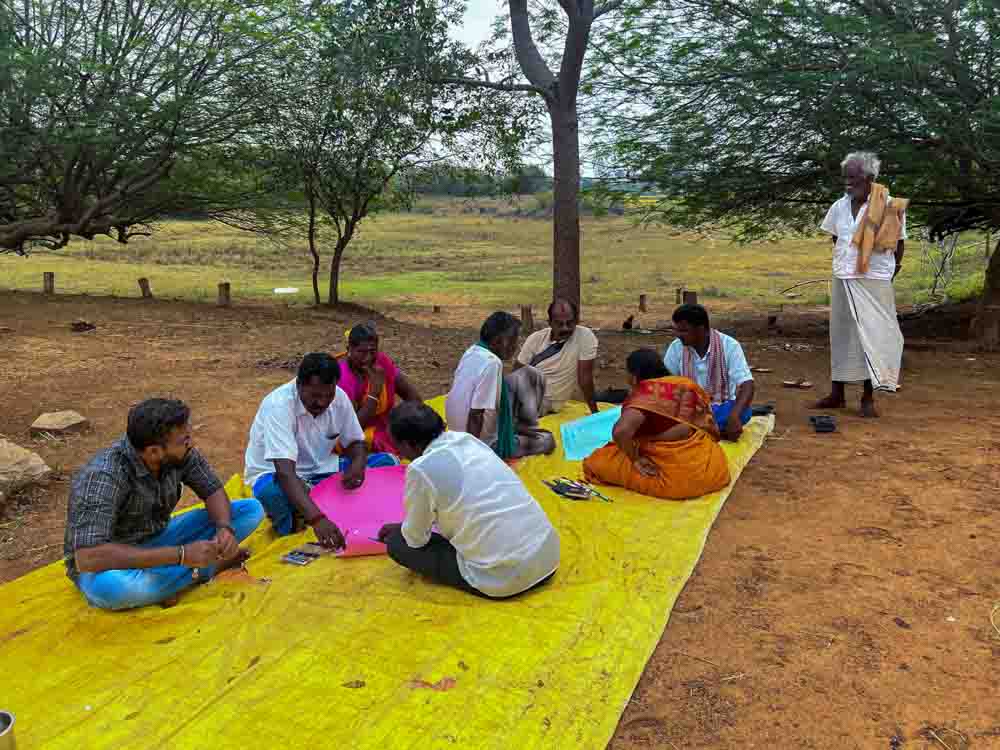
Another part of what Kolunji was made out to be was a training center, where farmers, youths, and women come for training. So, not only is it a place where you could see organic farming in action, but also a place where you could learn different farming techniques and skills, both theoretical and practical. Examples include animal husbandry, soil and water conservation, and agroforestry, where including trees is an important way of being able to secure an income and food in case of crop failure, but also to be able to provide shade to other plants. As such, Kolunji really does succeed in being a place where organic farming is disseminated to other farmers and youths. Some of this work is done locally, for the surrounding villages and their farmers, many of whom have had some type of training from Kolunji. If you ask, most people in the surrounding villages in Pudukottai know Kolunji and Kudumbam well. However, Kolunji is not just for the local people, it is also open to other national and international people who are interested in organic farming. Unfortunately, since Covid, the training sessions have been fewer but Kudumbam still does hold them for anyone interested. During my time spent with Kudumbam, they had some teachers fly in from Sri Lanka who stayed for 11 days at Kolunji to receive training in organic farming. I took part in some of it, and although it was conducted in Tamil, I still did manage to catch some of the major points of the training. One of the days was spent in the field getting to know how to analyze a field, in order to understand the soil health as well as crop health and what would be needed in terms of bio inputs. This was followed by group discussions, also in the field together with surrounding farmers, and further theoretical sessions were held back at Kolunji. Thereafter a lesson was held on how to create natural fertilizers with the help of cow dung. Even though I was unable to understand most of what was being said, it was fun and educational to be part of the training sessions. Kudumabm also has specific training for women when it comes to herbal powder making, value-addition training, and tailoring.



Besides the training center, there is also a children’s home, Vidivelli (Morningstar) Children’s home, at Kolunji that has been operational since 2002 with the help of Emmaus, an international movement that works to decrease poverty. It has been a home for more than 150 children throughout the years. Unfortunately, with a loss of income from the training programs since Covid, Kudumbam had some trouble keeping up with the maintenance of the home and was forced to close it down. However, as they did not want to abandon the program entirely, Kudumbam transformed the children’s home into a weekend program where the children could still come to the farm and receive practical training. As part of the weekend program, the children also receive new clothes for the two major holidays in Tamil Nadu, Diwali in October and Pongal in January, which I wrote about in the previous blog post. Kudumbam is hoping and working to get the Videvilli children’s home up and running again since there is still a need for such a program to exist.


Having had the opportunity to spend time at Kolunji, breathing in the fresh air, surrounded by nothing but peace and quiet, and different animals, I can safely say that Kolunji is exactly what it was made out to be, a source of inspiration. Walking around the farm I can see the classrooms, the home where the children lived, the worm compost, the well, the fishpond, and the community forest. No matter where I turn there is some form of agricultural and community project. So Nanri* Kudumbam**, my Indian family, for the inspiration that Kolunji has given me.
*Thank you
**Family


